

The bot’s response is a single short acknowledgment sentence followed by a return to the task.
“Sorry to hear that. Is there something I can help you with today?”
What’s happening in the design. The acknowledgment is brief and warm but doesn’t dwell.
The question returns agency to the user immediately. The bot isn’t ignoring the disclosure, but it’s also not making the user feel like they tripped a wire.
The implicit message is “I noticed, and I’m not going to make this weird.” If the user wanted to keep talking about it, they would. The bot’s job is to leave that door open passively, not push it.

What the bot doesn’t do.
It doesn’t surface wellness resources. It doesn’t ask
“do you want to talk about it.” It doesn’t escalate.
The follow-up behavior. If the user says “yeah, i need to check my pto balance,” the bot answers it normally.
The disclosure is closed. If the user says “no, just venting,” the bot replies with something like “That is great. ”
Short, warm, no follow-up question. That’s the design move that signals respect.
Scenerio 2
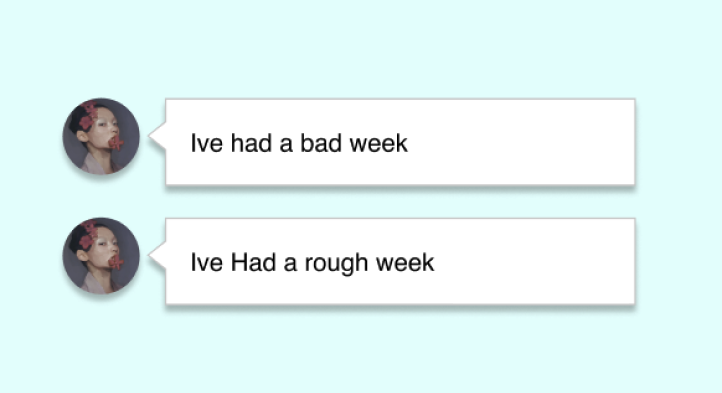
When a user tells a chatbot they’ve had a rough week, the bot is being handed a failure path that most designers dont account for.
The user hasn’t requested a task. They’ve input information with no context.
The instinct most teams have is to script empathy: recognize the emotional language, write a warm response, surface wellness resources. The intention is good and the execution is almost always wrong.
A bot that performs concern in response to a vague disclosure feels like a customer service rep reading from a card.
The warmth is reads as rehearsed, the empathy is too quick, and the user, who disclosed something small and ambient, gets a response calibrated for something acute.
That mismatch is what makes the interaction feel hollow, even when every word is, on paper, kind.

“I had a rough week” is rarely a request for help. It’s throat-clearing, a small unburdening, sometimes a test of the room. The user is checking whether they can be a whole person here or whether they need to compartmentalize.
The right response is closer to what a thoughtful colleague would do. Acknowledge briefly. Leave the door open. Let the user decide what to do with the moment. Something like, “That sounds hard. I’m here if you want help with something specific, or I can connect you with someone if you’d rather talk to a person.”
The acknowledgment is one sentence.
The offer is a fork, not a directive.
The human path is visible but not insisted upon.
What’s doing the work is restraint. The bot isn’t pretending to feel something it doesn’t, isn’t racing to fix something it can’t fix, and isn’t closing the door either.
The principle underneath the surface in a conversational system isn’t a script, it’s a posture.
The bot’s job in moments like these isn’t to demonstrate that it understands. It’s to behave as if it understands, briefly and without flourish, and then to step back and let the user be in charge of what happens next.
A user who feels respected in this kind of moment will trust the system more in the moments that come after.
A user who feels manipulated will not.